The failure rate in CRM projects is high – 6 out of 10 fail within a year
How can you make sure you’re in the 4 out of 10 ?
The success of your CRM project boils down to 2 areas:
- How you manage change in your business, and
- The level of customer focus within your processes

So what does a failed CRM project actually look like?
It’s not dramatic. Six months in, your sales team are back to tracking deals in spreadsheets. Customer data is scattered across inboxes and sticky notes again. You’ve spent tens of thousands of pounds on software that nobody opens.
People stop believing that anything will ever change, which makes the next project even harder to get off the ground.
How you manage change in your business
Change can include many things like,
- new software
- new ways of working
- a new product launch
- a new marketing campaign
- a revised enquiry form
- or the acquisition of a competitor.
How do you help staff deal with change ?
Three questions to ask yourself before you start
You don’t need a full change management programme on day one. But before you kick off a CRM project, sit down and honestly answer these three questions:
- Do my team know why we’re doing this? Not “we bought new software.” The real reason. Are we losing customers? Are we dropping leads? Are we wasting time chasing information that should be at our fingertips? If your team can’t answer this, you haven’t communicated it well enough yet.
- Who’s going to be affected, and have I talked to them? Not emailed them but, talked to them. The finance person who logs invoices, the engineer who picks up service tickets, the receptionist who takes the first call. If they feel like CRM is something being done to them rather than for them, you’ve already got a problem.
- What does ‘good’ look like in three months? Pick something specific. Maybe it’s “every new enquiry is logged in the system within 24 hours” or “sales can see overdue invoices before they call a customer.” Something small, measurable, and real. Not a vague goal like “better customer relationships.”
Get those right and you’re already ahead of most.
Where do you fit on this diagram?
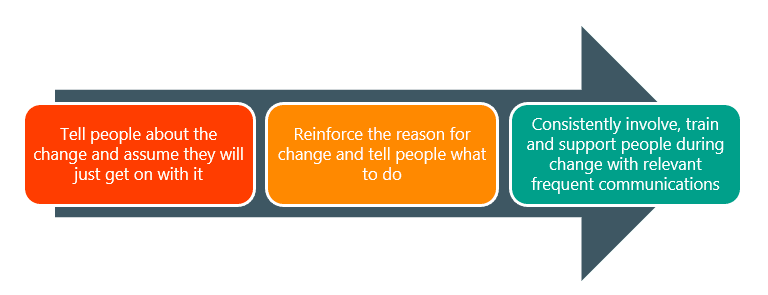
The further to the right you are, the more the change will be accepted by people in your business. This means:
- People being involved throughout the change process. People understand why the change is happening, what is changing, how it will affect them, and have confidence that they are being supported
- Faster adoption of change so people drop old ways of working faster
- People adapting to change quicker which increases productivity
- People advocating change and spreading the good word
- Less moaning about change
- Less resistance to change
- Less sabotage of change and spreading negativity!
There’s a massive amount of information, tools and techniques on change management on the web, in books and papers. You get to know which change tools to use in which situations through (sometimes bitter) experience. The sooner you start using them the better.
If you can ensure that every member of your team feels like CRM is relevant to them, is there to help them do their jobs better, and is designed around an improved customer experience, then you’re heading in the right direction…
This should be easy as you started off with this in mind in your CRM project, didn’t you?
How important are customer relationships to you?
I’ll let you into a little secret…every person in your business is responsible for building customer relationships.
Everyone.
This is obvious when talking about marketing, sales and service teams, but this also extends to:
- Finance staff who deal with invoices, billing and queries
- Projects staff who produce your service, or manufacturing staff who produce your product
- “Back end” office staff who take incoming phone calls or deal with customer queries
Are you customer focused?
You’ll hear the corporate word “customer-centricity” bandied about. All it means is simply:
Does every action you take provide a better customer experience?
I deliberately say “you”. Not “your business”. Not “your people”. You. Every single minute of every day the actions you take filter down to your team and influence the culture of your business. Over time your business becomes a reflection of your values and actions.
If you’ve built up a high performing team then you already know how important the customer experience is. People buy from people. You spend hours building up and maintaining relationships with people. These relationships must consistently be of value to both sides. They are made up of phone calls, meetings, emails, letters, and social media interactions. You’re always listening out for interesting things about that person which give more depth to the relationship.

You’re driven to make sure that every relationship and experience with your business is the best that it can be.
This knowledge about relationships lives all too often in people’s heads. CRM is about capturing as much of this as possible within a system. A system that anyone can access that tells them:
- Who is related to who and when did that relationship start?
- How frequently have we contacted someone?
- Have they ever expressed interest in our products and services?
- How many orders has that person placed?
- Where is their order or project currently up to?
- When will their order be fulfilled or their project completed?
- How many times have they raised customer service issues?
- What’s recently changed in their business and can any of our products or services help them?
- Who is late paying an invoice, do you need to stop servicing them until it’s been paid?
CRM involves everyone in your business
Getting everyone in your team to capture relationship data within CRM is no small feat. It relies on consistently involving them in improving the customer experience you provide over time.
Once you’re routinely capturing this data you’ll stand a much better chance of getting into the “top 4” and having a successful CRM project.
A couple of examples to demonstrate this:
- Finance staff will update the system with overdue invoices so sales staff know whether their customer is a good payee before they approach a new opportunity.
- Projects staff will flag successful milestones in the system so that sales staff can promote this to their customers. Support staff or engineers can use this information to know when the project’s success triggers the start of their workload to help with planning.
Implementing Dynamics Series
- How to develop a Dynamics 365 project plan and brief
- How much does Dynamics 365 cost?
- How long does it take to implement Dynamics 365?
- Dynamics 365 Project Implementation Explained
- Choosing the right Dynamics partner
- What to expect in the first 30 days of a Dynamics 365 project
- Why do CRM projects fail?
- 10 actionable ways to improve CRM user adoption